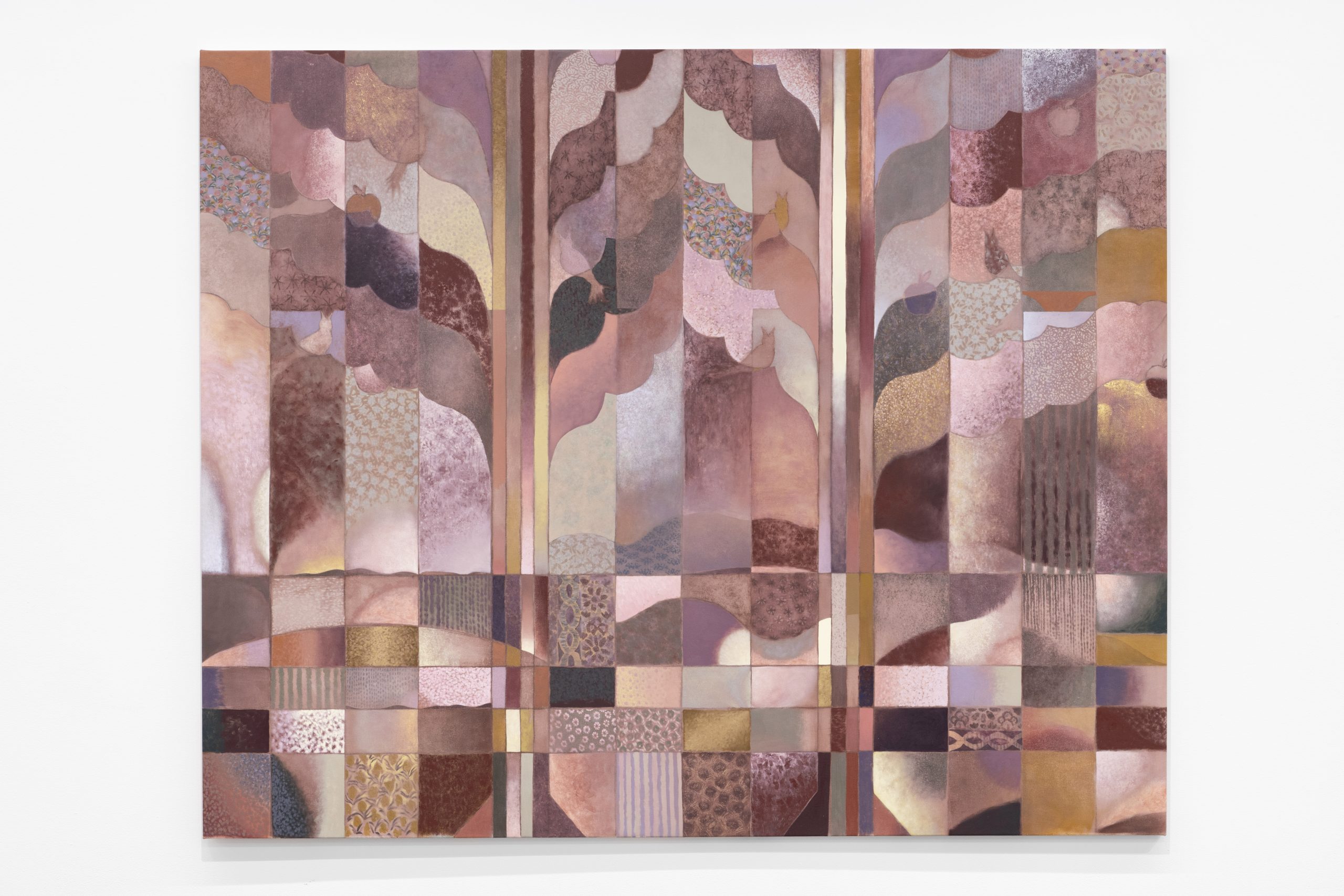
Alexandre Pépin’s paintings locate fleeting instances of connection, desire, or joy within the everyday – two men entangled in tall grass, a single figure immersed in a verdant landscape, a pair of lovers read side by side. His paintings are often catalyzed by a feeling of earnestness or sincerity. Through the process of painting and his specific alchemy of material, colour, line, and texture, Pépin complicates this initial feeling, giving visual form to the ambiguity and complexity of intimate relationships that can often elude language.
Pépin draws variously and voraciously from histories of painting. His predilection for surface detail and his paintings’ particular geometries recalls both Byzantine frescoes and the work of Viennese Secession painters. His ebullient landscapes and intimate depictions of everyday life echo the work of Post-Impressionists such as Pierre Bonnard, Édouard Vuillard, or Canadian landscape painter David Milne. His fascination with simplified, planar forms and traced lines speak to the influence of queer contemplative modernists, such as Forrest Bess, Agnes Martin, Morris Graves, and Etel Adnan. For Pépin, this web of painterly and historic references is both a celebration of the medium of painting, but also a way to position queer subjects, in the artist’s words, “in a vast continuum of time, as something that has always been part of the world, and always will be.”
Line and geometry serve as a connective tissue within individual paintings and across Pépin’s broader body of work. His paintings are segmented into planes of fragmented space, a strategy that visually echoes quilt-making, stained glass, architectural drawings, or constellations. This geometric structure both confuses and coheres the spatial logic of his paintings; subject and structure coalesce into a single web, creating works that flow between figuration and abstraction, and insist upon the importance of texture, colour, and light.
Pépin’s process vibrates between spontaneity and structure, speed and slowness, levity and gravity. He often begins his paintings by drawing in pastel to loosely articulate an idea or a rudimentary structure. He then creates playful forms in bold, saturated colours that channel his intuition, subjectivity, queer sensibility, and his sheer enjoyment of painting. Pépin tempers this initial expression of ecstasy with muted earth tones and texture, adding layer upon layer of glaze and pigment until he reaches his desired balance. The resulting compositions hum with tension between hope or joy, life’s inherent pain and mundanity, and the slippery, inelegant fallibility of the human body. Pépin’s paintings ask for time and attention. They reveal their painterly depth and the cumulative potential of their many layers slowly, in deliberate contrast to the bombardment of an algorithmic scroll.
Exhibition Media