

For Brendan Fernandes, dance is political, celebratory, and collaborative, offering a language to proclaim visibility, assert identity, and to seek connection or joy. As a queer, young newcomer to Toronto, dance gave Fernandes community, belonging, and a means of creative expression. After an injury ended his dance career prematurely, Fernandes turned to visual art, building a multidisciplinary practice that raises questions around migration, systemic injustice, colonial legacies, and the complexities of identity, often guided by his personal and familial history. Sitting at the intersection between dance and visual arts, Fernandes’ work is often, in his own words, “part ballet, part queer dance party, part political protest.”
Other Moves opens with a poster-multiple that asks: when you are on the dance floor, what song makes you feel free? For Fernandes, the dance floor is a space of resistance and resilience, a structure that offers physical support and creative agency, and a space of profound vulnerability. It is also a sanctuary for queer community and joy that cannot be taken for granted amidst sustained and targeted violence towards queer and trans communities. Inspired in part by the Fluxus movement of the 1960s, and the downtown Manhattan performance art scene of the 1980s, When You Are On the Dance Floor, What Song Makes You Feel Free? beckons us all to participate in the liberatory space of the dance floor.
The three other bodies of work in the exhibition bring together performance, photography, textile, and sculpture to consider movement as an expression of solidarity, an assertion of presence, a means of seeking connection, and as embodied resistance to oppressive, colonial structures. Noise See centers around a collection of quilted tapestries that are inspired by Maasai shuka – vibrantly coloured plaid or checkered textiles that are highly significant within contemporary Maasai culture, but also speak to legacies of colonialism in Kenya and Tanzania. These tapestries are activated by a pair of dancers in both a performance and a series of photographs. Shrouded by the textiles, the dancers merge and entwine, becoming an indistinguishable whole. The tapestries become a sort of shield or second skin, protecting the performers’ identities, while the shuka pattern renders them nonetheless hyper-visible.
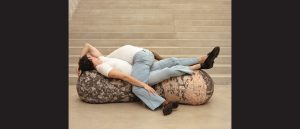
In Two offers a response to the work of Scott Burton, a 20th century American artist whose work broadly considered queer culture in public spaces. In turn, the photographs, soft sculptures, and textiles that comprise In Two are a collective ode to the culture of cruising within queer communities, or the act of seeking connection through gestures or signals that are undetectable to those not in the know. Both Noise See and In Two situate movement as the body’s language to signal belonging and seek connection, and consider the complicated dance between visibility and invisibility for marginalized communities moving through public spaces.
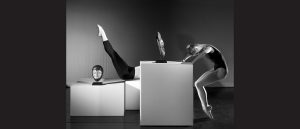
Fernandes is also acutely aware of the hierarchical and colonial histories of both the dance and museum spheres in which he operates. Classical ballet and Western museum collections both emerged partially as expressions of courtly or state power and hierarchy. As One brings together two classical ballet dancers with West African masks from the Cravens Collection at the University of Buffalo Art Galleries. While the dancers gesture in deference to the masks, the masks inevitably remain decontextualized from their communities of origin, their makers and wearers absent and unnamed. A nearby series of steel sculptures, Stand Taller, evoke both dancerly bodies and the armatures used to display such masks in museum settings. Enlarged to a greater-than-human scale, and brought into the physical space of the gallery, these empty armatures point to absence, and the sustained cultural misappropriation and thievery that underpin museum collections. Cumulatively, Fernandes’ practice is insistent on the presence of those who have historically been made absent, asserting the collective power of their bodies and the possibilities of solidarity through movement.
Performance
Noise See
Friday 20 November, 6-8 PM

Noise See is a performance work by Canadian visual artist and choreographer Brendan Fernandes. Originally commissioned by The Fabric Workshop and Museum, Philadelphia, the work explores themes of visibility, protest, the legacy of empire, and embodiedresistance. Central to the performance are vibrant quilted tapestry costumes that evoke textiles commonly associated with contemporary Maasai culture in Kenya yet rooted in British colonial influence.
Presented alongside the exhibition Other Moves, Noise See is performed as a duet: two dancers engage in a choreographic dialogue— merging and separating, concealing and revealing—through their bodily interaction with one another and their own biomorphic form as they inhabit their costume. These dynamic textiles become agents of action, shaping and being shaped by the dancers’ movements.
Noise See reclaims a colonial textile legacy and transforms it into a site of protest, protection, and presence. Here, Fernandes insists that silence is not absence but a resonant and radical form of resistance.