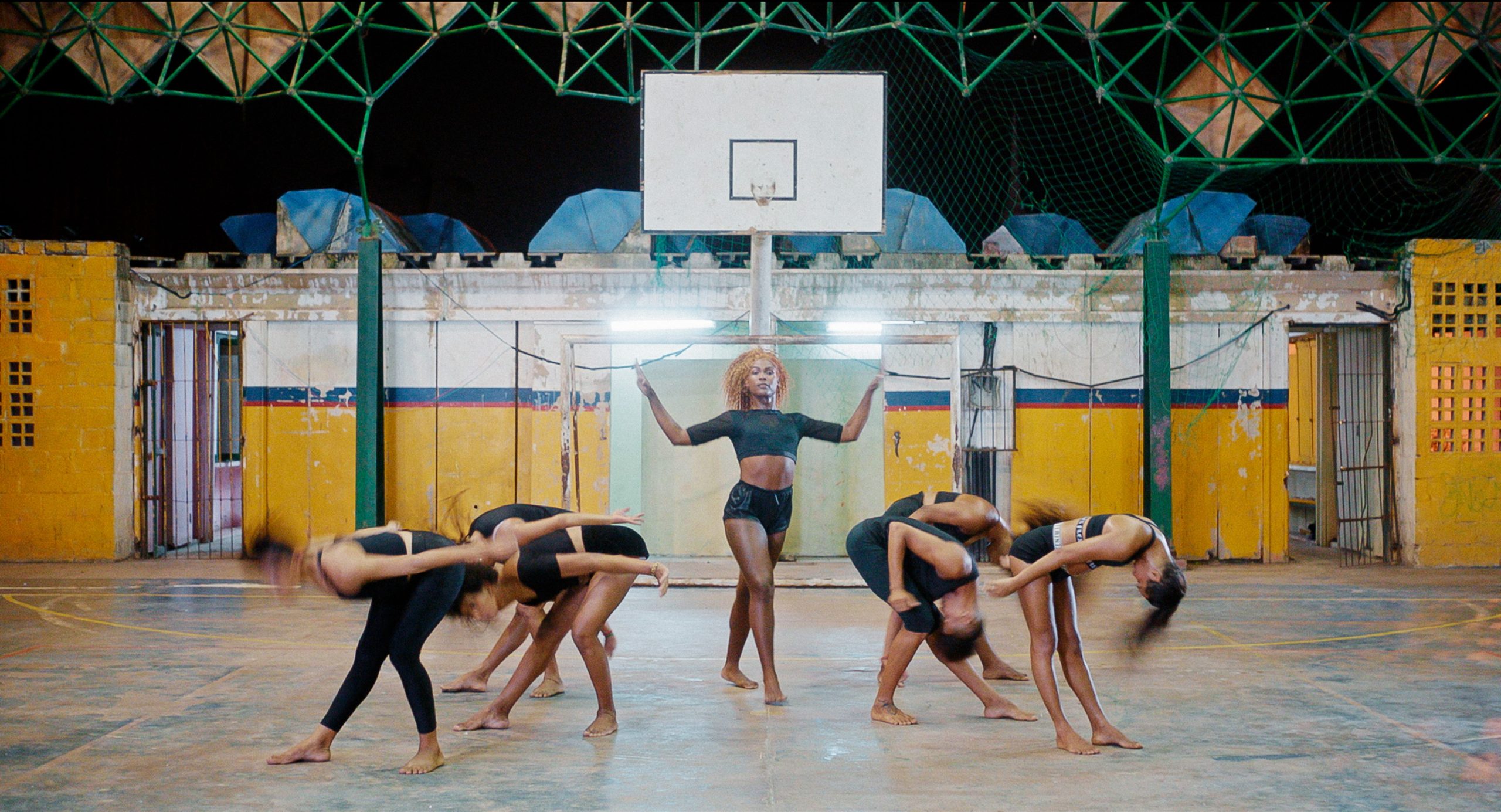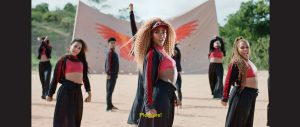
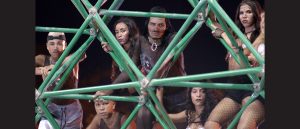
Developed in close collaboration with three competitive dance groups from the peripheries of Recife, Brazil, Swinguerra (2019) celebrates music and dance as powerful forms of self-definition, solidarity, and resistance to the status quo. Presented at the Brazilian Pavilion at the 58th Venice Biennale, the work follows performers – many of whom are Black, transgender, nonbinary, or queer – as they rehearse and compete in dance styles including swingueira, brega funk, and passinho da maloca. Rooted in the cultural traditions of Northeast Brazil while also evolving and responding to contemporary urban life, these forms of movement and competition become vehicles through which dancers assert identity, forge community, and imagine new possibilities for belonging.
In their filmmaking practice, Wagner & de Burca engage in long-term relationship building and a collaborative process of working that prioritizes “the complexity of an encounter.”1 Performers bring their own histories and embodied knowledge to the work, and while the line between reality and fantasy is often narratively fluid, the precision, stamina, theatricality, and technique of each performer are expressions of their lived experiences and an assertion of self-representation.
The work’s title combines swingueira, the dance style, with guerra, the Portuguese word for “war” – a fusion that suggests the call-and-response of competitive dance battles. Installed across two facing screens, Swinguerra indeed echoes the structure of a dance battle, placing the dancers in rhythmic dialogue rather than direct opposition. Gestures, formations, and glances pass between the screens, and extend to the viewer, who is positioned within the exchange. This dynamic choreography foregrounds collaboration as much as competition and emphasizes how individual brilliance emerges through the support of collective practice.
Historically, music and dance in Brazil have served as vital forms of cultural continuity and political expression, particularly among Afro-Brazilian communities whose histories are intertwined with the legacies of colonization and the transatlantic slave trade. Swinguerra situates contemporary dance within this longer history, where choreography becomes both a celebration and a poetic form of survival. Dance has long offered the possibility of inhabiting space differently: for individuals to claim visibility where they have been excluded, to build kinship where they have been isolated, and to express identities that transcend dominant social norms.
Made in 2019, during the first year of Jair Bolsonaro’s presidency, Swinguerra also emerged at a moment of intensified conservative attacks on LGBTQ+ rights and on public discussion of gender and sexuality in Brazil. Against this backdrop, Swinguerra presents movement not as an escape from political realities but as a way of transforming them. Every synchronized step, subversively sexy lyric, and shared rhythm becomes a claim of agency. In the face of ongoing social inequality and discrimination, the work reveals dance as a living language through which communities continue to define themselves, care for one another, and insist upon the freedom to be seen on their own terms.
—
1 Luchetti, Matteo, “Bárbara Wagner & Benjamin de Burca on the Complexity of an Encounter,” Extra Extra Magazine, No. 13, 2019, 142.
Images: Bárbara Wagner & Benjamin de Burca, Swinguerra, 2019. Still. © Bárbara Wagner & Benjamin de Burca. Courtesy the artists and Fortes D’Aloia & Gabriel, São Paulo/Rio de Janeiro.
Exhibition Media